
Why Handwrite a First Draft?
On the Moral Life of Pen and Ink

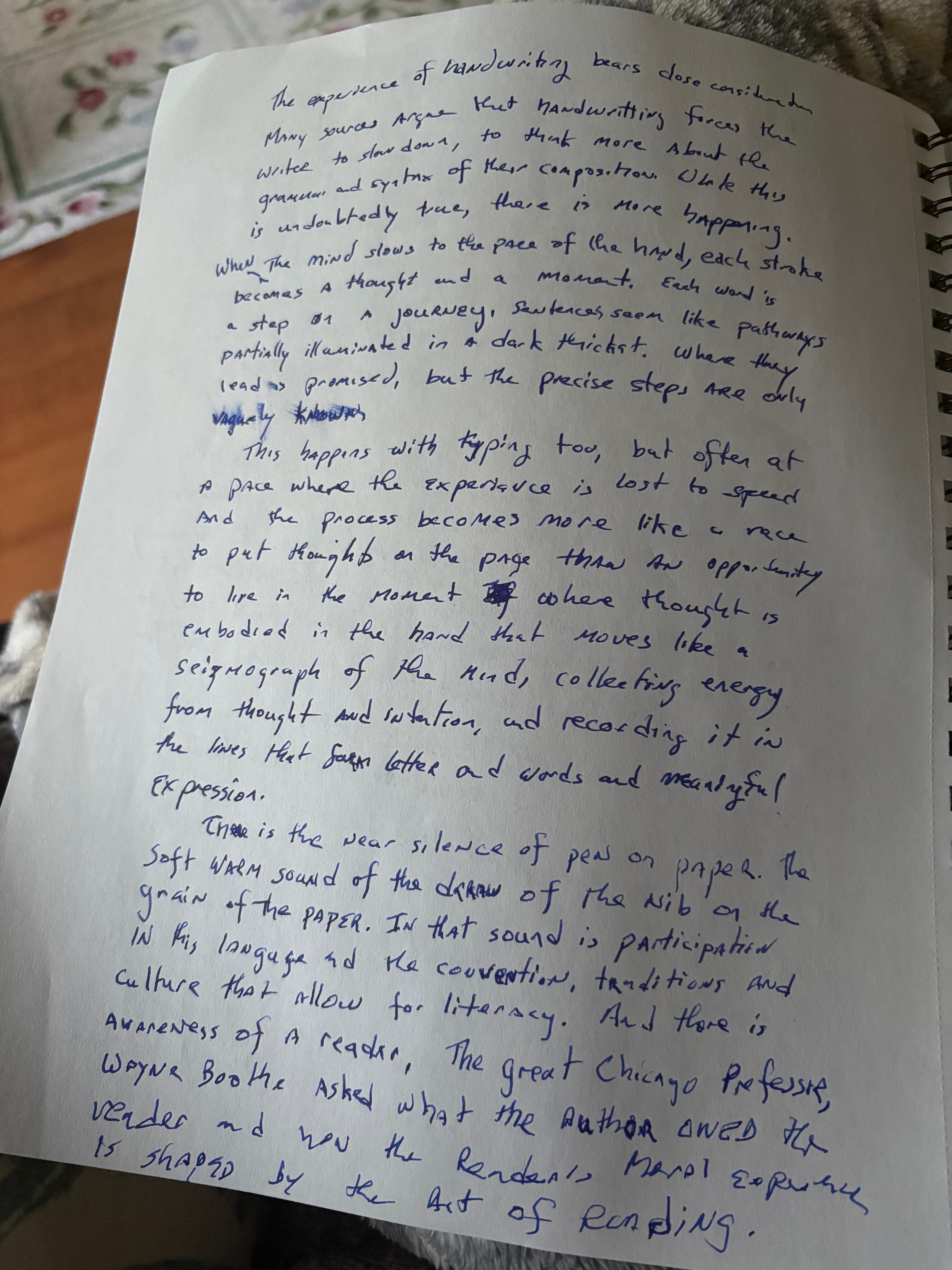
We are living in an age of unprecedented textual abundance. A generation ago, computers made writing faster. Today, large language models can produce pages in seconds. For the first time in history, the difficulty of writing is no longer producing text. Text is everywhere. It can be generated, revised, summarized, expanded, and reformatted almost instantly.
This achievement is remarkable. I use these tools myself and often find them helpful. Yet their very power raises a question. If machines can produce competent prose in moments, then what is writing for? If words can be manufactured at scale, what remains uniquely human about the act of composition?
For much of my life, I assumed the answer had something to do with efficiency. When I was young, there were typewriters, which I never mastered. I relied on others—first my girlfriend, who was later my wife—to type my handwritten drafts. They did so generously and patiently, often out of love. Handwriting was not a preference. It was simply how writing began.
When personal computers entered my life, they felt liberating. I could write and revise my own work without imposing on anyone else. Entire paragraphs could be moved with a keystroke. Drafts that once required hours of retyping could be transformed in minutes. It was a genuine breakthrough.
Yet something was lost. The endlessly editable screen encouraged a subtle form of haste. Because words could always be changed later, there was less reason to dwell on them now. Ideas appeared on the page before they had fully taken shape. Revision often became a substitute for reflection. Sometimes the revisions never came. Other times, they arrived only after the argument had become tangled and obscure.
Professional writing deepened the problem. Academic and legal writing rewards productivity. We are expected to produce articles, memoranda, reports, lectures, emails, and now digital content at an ever-increasing pace. The pressure for volume and efficiency runs against the quieter demands of thought. There is always another deadline waiting, another document to complete, another audience to address.
Large language models accelerate this trend still further. They can generate in seconds what once required hours. The temptation is obvious: to move immediately from intention to finished prose, bypassing much of the slow work of composition. Used wisely, these tools can be valuable partners. Used carelessly, they can reinforce the assumption that writing is primarily the production of text.
But writing is not only the production of text. Many defenders of handwriting argue that writing by hand improves thinking because it slows the writer down. There is truth in that claim. The hand moves more slowly than the keyboard. The pace encourages greater attention to words, syntax, and structure. Yet I have come to believe that the deepest value of handwriting lies elsewhere.
Handwriting slows us enough to remember that writing is an act of participation. When thought moves at the pace of the hand, each sentence emerges through a series of deliberate embodied gestures. Each word requires commitment. The writer cannot rush ahead as easily. Attention settles on the page. One begins to inhabit the process rather than merely manage it. At such moments, writing ceases to feel like the transfer of information from one mind to another. It becomes an encounter.
The insight came to me many years ago through Wayne Booth, the great teacher and literary critic at the University of Chicago. Booth continually returned to a deceptively simple question: What does an author owe a reader?
The question appears technical at first. In reality, it is profoundly ethical. Behind every act of writing stands another human being. Not a demographic category. Not an audience segment. Not a consumer of information. A person. That reader possesses a history, relationships, hopes, fears, memories, and experiences that the writer can never fully know. To write responsibly is therefore to acknowledge the limits of one’s understanding. It is to recognize that meaning is not created by the writer alone but emerges in the space between writer and reader. The writer must learn to receive the reader before attempting to persuade, instruct, or influence.
Handwriting encourages precisely this disposition. Its slower rhythm creates room for another person’s presence. The reader becomes less an abstraction waiting at the end of a process and a companion whose eventual encounter with the words matters during their composition.
The experience is difficult to describe. It is present in the near silence of pen on paper. It is present in the faint sound of the nib moving across the grain of the page. It is present in the awareness that language itself is something received before it is given. Every word belongs to traditions, conventions, and communities that precede the individual writer.
In that sense, writing is always participation. We participate in a language we did not create. We participate in conversations that began before us. We participate in communities of readers and writers extending across generations. And through writing we offer ourselves back to those communities.
Handwriting makes this reality easier to perceive because it slows the act sufficiently for us to experience it. This is why I continue to write many first drafts by hand. Not because handwriting is efficient. It is not. Not because it guarantees better prose. It does not. And certainly not because technology is the enemy. It is not.
I write first drafts by hand because the practice reminds me what writing is. In an age when text can be generated almost instantly, handwriting preserves the experience of composition as a human encounter. It reminds me that writing is not merely about producing words but about meeting another person through them.
Wayne Booth taught that authors owe something to their readers. Writing by hand is one way I remember that obligation.
The blank page is not merely a place where text is made. It is a place of encounter, where writer and reader begin to meet before either fully knows the other. To write there slowly, with attention and care, is to participate in one of the oldest and most deeply human forms of community.