
Everything Is Not Information

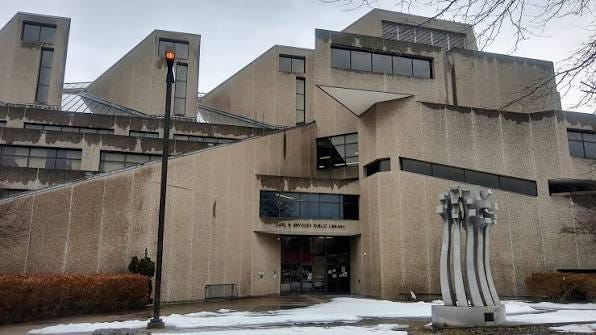
My mother took me to the Earl W. Bridges Public Library in Niagara Falls, New York, almost every weekend the year it opened. I was 14, and to me it was heaven. It was there, long before I had any language for it, that I began asking the big questions about what kind of world we live in, what kind of beings we are, and what our place in reality might be. Years later, reading a book about 3-D printing and intellectual property, I came across a sentence that startled me: “Everything is information.” I remember it as the opening sentence. Apparently, it was not. Memory has a way of editing texts, sometimes usefully. It preserves the sentence that seemed to reveal what the book was really about. Three-dimensional printing made the claim seem almost obvious. An object could be scanned, translated into a digital file, transmitted across the world, and reconstructed somewhere else. Matter appeared contingent. The pattern endured. What was most real about the object seemed to be the information that allowed it to be reproduced. But “everything is information” is not merely a description of a technology. It is an unsupported ontological claim. It makes a claim about what reality is.
I did not fully appreciate that when I first read it. At that moment, I was interested in the intellectual-property problems created by the separation of design from manufacture. What exactly had been copied? The object? The design? The file? A set of instructions? Which aspect of the thing persisted as it moved from physical object to digital representation and back to physical object? Those questions seemed doctrinal. I knew that it was also implicating much bigger questions about the nature of reality, the person, the moral meaning of human existence, and the place of the human in the cosmos.
A scanner does not convert an object into information. It measures selected features and encodes them for a purpose. A digital manufacturing file does not contain the object itself. It does not contain the history of the object, its material capacities, its uses, its cultural significance, or its place in a human practice. It contains enough of a certain kind of information to permit a machine, supplied with materials and operating under particular conditions, to fabricate something that resembles it in specified respects. That is an astonishing technical achievement. It is not proof that everything is information.
Yet the sentence captures one of the characteristic temptations of our time. Because we can represent something as information, we begin to believe that the representation tells us what the thing really is. That temptation now extends far beyond manufactured objects. Persons become data profiles. Intelligence becomes prediction. Judgment becomes information processing. Institutions become communication networks. Legal opinions become collections of tokens whose patterns can be learned and reproduced. Meaning becomes correlation. The engineering requirement that the world be rendered as information begins quietly to function as a metaphysics. I have been trying, in one way or another, to understand this problem for most of my life.
The Big Questions
My mother died four years ago this month.
She took me to the library almost every weekend. I can still remember the sense of possibility contained in those visits: the rows of books, each one opening toward some part of the world that I had not yet considered. She bought me a subscription to Natural History because she noticed that. I liked to read Stephen Jay Gould’s book, The Panda’s Thumb, which I took out of the library many times. I read his essays about evolution, contingency, extinction, adaptation, and the enormous strangeness of life.
Gould had the gift of making scientific questions feel inseparable from questions about what it means to be human. He wrote about fossils and baseball, evolutionary theory and cultural history, the Burgess Shale and the human tendency to mistake contingent outcomes for inevitable progress. Science, in his hands, enlarged rather than diminished the world. My mother understood that her 14-year-old son was drawn to that enlargement.
For as long as I can remember, I have asked some version of the question: What is the human place in reality? I doubt that I could have formulated it clearly when I was young. But I felt its importance. I wanted to know what kind of world this is, what kind of beings we are, and how human life fits within whatever larger order reality possesses.
In college, that question led me toward religion and philosophy. Religious studies still asked questions about cosmology that much modern philosophy had ceased to ask or had confined to specialized corners of the discipline. Religious traditions offered accounts of the structure of reality, the nature of the person, the relation between time and eternity, the sources of suffering, the character of moral obligation, and the possibility of transformation. Comparative religion delightfully complicated all of these questions. Different traditions did not merely offer different answers to a common list of philosophical problems. They sometimes organized the problems differently. They understood selfhood, agency, time, causation, suffering, liberation, and ultimate reality in ways that could not easily be translated into one another.
That was one reason I became interested in Buddhism, particularly Japanese Buddhism. It offered conceptions of relation, impermanence, dependent arising, practice, and selfhood that did not fit comfortably within the substance-centered metaphysics I had inherited from much of Western thought. Later, I found resonances in Whitehead. Reality, on his account, was not fundamentally composed of static substances but of events, relations, and processes of becoming. I do not think contemporary physics simply proves Whitehead correct. Nor do I think quantum theory proves Buddhism. Those are the kinds of claims that should make one suspicious. But the resonances matter. They suggest that some intellectual traditions were more prepared than others for a world understood as relational, dynamic, and emergent.
Law, for Practical Reasons
I went to law school initially for the usual practical reasons. Law offered a profession. It offered a way to participate in public life. It promised a reasonably stable place in the world and a form of socially recognizable usefulness. I did not begin by thinking that jurisprudence was another way of asking about the human place in reality. That realization came gradually.
Jean Bethke Elshtain was crucial. Under her influence, political thought became something more than a competition among abstract theories of justice or institutional design. It became an inquiry into persons, families, communities, responsibilities, loyalties, forms of authority, and the conditions under which a common life becomes possible. Elshtain understood that political and legal theories always rest upon some conception of the person. The autonomous chooser of liberal theory, the class-bearing subject of Marxist theory, the citizen of republican theory, and the dependent, relational person of Christian realism are not interchangeable units. Each carries with it a different understanding of what human beings are and what political life is for.
At the same time, I was invited to a seminar on law and religion. Work in religious studies required me to wrestle with Clifford Geertz and with comparativists who understood religions as systems of meaning rather than merely collections of propositions. Geertz’s anthropology made an enduring impression on me. Human beings live, as he famously put it, within webs of significance they have spun. Human action cannot be understood simply by recording bodily movements or observable behavior. A twitch and a wink may be physically similar. They are not the same action. The difference lies in meaning, intention, convention, and social context. It lies in the interpretive world within which the action occurs. This is not an invitation to mysticism. Meaning is publicly embodied in symbols, practices, institutions, histories, and forms of life. It is real even though it cannot be reduced to a description of muscular movement.
Robert Cover brought this insight directly into jurisprudence. Like Geertz, Cover understood that law exists within a normative universe made by narratives, commitments, communities, practices, and institutions. Law is not merely a set of rules announced by officials. It is part of the world through which people understand who they are, what they owe one another, and what sacrifices their commitments may require. Official law is often jurispathic. It kills legal meanings and normative worlds. A court does not merely select among abstract interpretations. Its decision is backed by force and may suppress the lived normative order of a community. Geertz and Cover form a pair. Geertz understood that human beings inhabit worlds of meaning. Cover understood that law creates, sustains, and destroys those worlds.
The best law-and-religion scholarship also understood that law and religion are not simply neighboring regulatory systems. They are deeply engaged systems of thought and practice. Both interpret reality. Both locate persons within an order of meaning. Both establish relations among authority, obligation, community, memory, and hope.I would later come to think of law and religion as systems of co-constraint, each positioning the other in a dance that is generative and responsive to the time and place where each is practiced. Thus, law, I came to see, was always involved in the big questions. I simply had learned not to call them that.
The Modern Mind
Susanna Blumenthal’s highly praised book, Law and the Modern Mind, provides historical support for this intuition. Blumenthal shows how American law struggled in the nineteenth century with changing accounts of consciousness, capacity, responsibility, self-command, and mental disorder. Courts did not simply apply a stable and universally accepted conception of the human person. They participated in constructing what counted as a legally responsible mind. Judges, lawyers, physicians, and other authorities confronted competing accounts of sanity, intention, passion, weakness, and agency. These accounts shaped criminal responsibility, contractual capacity, testamentary freedom, and other ordinary legal doctrines. The history is important because it shows that jurisprudence is never metaphysically neutral. Law must decide what a person is, what an action is, what counts as a cause, where agency is located, and what makes an outcome attributable to someone. It cannot function without answers to these questions. Often those answers are hidden inside doctrines. They appear as rules concerning intent, causation, capacity, personhood, ownership, authorship, responsibility, and corporate action. Because the questions are translated into legal categories, lawyers can imagine that the metaphysical work has already been done. It has not. It has merely become implicit.
Blumenthal’s focus is historical. She reconstructs an earlier transformation in the legal understanding of the mind. But her work suggests a larger project: an intellectual genealogy of law organized around changing foundational pictures of reality. Here I would draw on a seminar participant from that Law and Religion project I took part in so many years ago: Charles Taylor. His concept of the social imaginary offers a useful way to describe this. A social imaginary is not simply an explicit philosophical theory. It is the background understanding through which people imagine their social existence: what persons are, how they relate, what institutions do, what kinds of authority are legitimate, and what forms of action are possible. Metaphysical and scientific ideas do not move directly into legal doctrine. They enter the social imaginary. They become common sense to those living in a time and place. They shape institutions and practices. Eventually they become difficult even to see. Law gives those background assumptions institutional form and coercive force.
A New Social Imaginary
More than a decade ago, I began paying close attention to legal technology because I realized that another transformation was underway. At first, people presented legal technology largely as a matter of efficiency. Computers would accelerate research, improve document review, lower costs, and automate routine tasks. But as I studied the foundational science of the technologies, I realized that they rested upon deeper claims. They treated legal materials as information that could be extracted, classified, correlated, and predicted. They represented persons through data. They treated judgment as a form of information processing. They modeled institutions as systems of inputs, outputs, incentives, and communication flows.
Artificial intelligence has intensified the shift. A predictive system must decide which features of a person are relevant. A language model must represent legal meaning through patterns within data. A risk-assessment system must infer the future from recorded regularities in the past. An autonomous or semi-autonomous system requires decisions about where agency lies and how responsibility should be distributed among designers, deployers, users, organizations, and machines. These are technical design questions made possible because of insights gained from high-dimensional mathematics, information theory, and complex systems analysis that were unavailable to the legal thinkers of Bluementhal’s nineteenth century.
Legal technology does not merely apply law to facts. It helps determine what will count as a fact. It shapes how we answer questions about what is a person for the purposes of the system? What is a legally relevant action? What makes two cases alike? Is intention a hidden mental state, an inference from behavior, or a convention attributed for institutional purposes? Is an organization an aggregate of individual human choices, or does it possess a causal structure of its own? Is human review a meaningful intervention or merely another stage in an automated process? It does not merely assist judgment. It embodies a theory of judgment.
It does not merely represent people. It establishes which aspects of persons will become visible to institutions. This was the significance of “everything is information.” The sentence expressed more than technological optimism. It expressed an emerging social imaginary.
Educating Myself Again
Once I saw this, I realized that my existing education was not enough. I began to educate myself again. I studied Shannon’s theory of information. Shannon’s great achievement was to abstract the engineering problem of communication from the meaning of the message. Information theory made it possible to measure uncertainty, encoding, transmission, and noise without first determining what a message meant. That abstraction helped make the information age possible. But an abstraction created for a purpose can become dangerous when it is mistaken for a complete account of reality.
The technical separation of signal from meaning can become a social imaginary in which meaning appears secondary or dispensable. The fact that persons can be represented through data can become the assumption that the data exhausts the person. The success of prediction can become the belief that prediction is equivalent to understanding. I studied statistics because contemporary governance increasingly speaks through probabilities. I studied complex systems because many of the harms created by institutions and technologies cannot be understood as the linear effects of isolated decisions. I studied emergence, causal organization, and multiscale explanation because reality does not appear to reserve all genuine causation and explanation for its smallest components.
I read deeply in contemporary metaphysics and philosophy of science. Ladyman and Ross were especially important because they insisted that metaphysics must be continuous with our best science. They rejected both speculative philosophical system-building detached from scientific practice and the assumption that reality must consist fundamentally of little self-subsisting things bearing intrinsic properties. This raises questions for me about how the cosmologies I studied in comparative religion might be relevant (if at all) to contemporary legal thought, where Christian legal theorists still nostalgically cling to Aristotelian essentialism despite lack of scientific grounding and in the face of post-humanist deconstruction. They assert essentialism not as a faith claim but rather as a self-evident truth.
The emerging picture is not settled. But across physics, biology, information theory, and complexity science, reality increasingly appears relational, processual, dynamic, and organized across multiple scales. Aristotelian hylomorphism can no longer be offered as self-evidently true.
Objects may be stable patterns rather than metaphysically independent substances. Higher-level structures may be real without being fundamental. Causation may belong to organizations and systems as well as to individual components. Information may describe physically instantiated differences and relations without constituting an immaterial substance from which everything is made. This is a far richer picture than “everything is information.” And it is more challenging for law.
Why Jurisprudence Needs Metaphysics
Contemporary legal thought often treats metaphysics as an embarrassment. The word suggests scholastic distinctions, theological speculation, or questions that cannot be resolved and therefore should not interfere with practical judgment. But information science and legal technology have made that posture untenable. Lawyers cannot govern artificial intelligence responsibly without deciding what legal reasoning is. It cannot assign responsibility without determining where agency exists. It cannot protect human judgment without understanding what judgment entails. And it cannot regulate automated decision-making without examining the relation among information, meaning, prediction, causation, and action. Lawyers need metaphysics today not because lawyers should begin deducing rules from abstract first principles but because legal technologies are already installing ontological assumptions within institutions.
The relevant contrast is not between metaphysics and practicality. It is between explicit, revisable, scientifically informed metaphysics and hidden metaphysical speculations embedded in the systems of legal technology. Every computational system uses abstractions. That is unavoidable. Law itself is an architecture of abstraction. The danger begins when the abstraction becomes commonplace to the user: when the representation required by the system is mistaken for the reality represented.
The Human Place in Reality
This returns me to the question that has haunted me. What is the human place in reality? I encountered that question early on through religion, philosophy, and the natural world opened to me by books. My mother helped make that life possible. She took me to the library. She subscribed to Natural History. She encouraged the questions even when neither of us knew where they would lead. They led through comparative religion, Buddhism, Whitehead, Elshtain, Geertz, Cover, Blumenthal, Shannon, complexity, artificial intelligence, and contemporary metaphysics. For a long time, these may have appeared to be separate interests. I no longer think they are.
They form an inquiry into the way human beings understand reality and construct institutions within that understanding. Law is one of the principal institutions through which a society makes its picture of reality authoritative. Legal technology now gives that picture computational form. The task for jurisprudence is to understand this transformation before its assumptions become too deeply embedded to question. The obstacle is a profession that is often more driven by commercial goals rather than understanding the nature and purpose of law. That is what academic institutions are for, but too often they are more focused on serving the profession rather than leading it. That means subordinating the pursuit of truth to the goal of making legal practice commercially exploitable.
The task for legal education is therefore urgent. Lawyers cannot govern technologies whose foundational claims they do not understand. It is not enough to learn how the systems work, how to use them efficiently, or how to comply with emerging regulations. Lawyers must be able to ask what picture of the person, agency, meaning, causation, and responsibility the systems presuppose. “Everything is information” is a seductive sentence. But it is unsupported and naive. It should be seen as irresponsible to build a legal system based on it. It captures the astonishing power of representation. But it also reveals the danger of confusing what can be encoded with what is real. The human person is not less than information. But neither is the person exhausted by information compressed into an algorithmic expression. The future of jurisprudence may depend upon remembering the difference.
The law has already given "personhood" to non-sentient (yet intelligent in their own way) hive minds like corporations, so there is some fuzziness with who the "person" at the center might be with a non-objective and continuing evolution of the view of what is and isn't a "person" by the law. I'm not sure that "law" is a better option than empirical science and information theory, but you've certainly given me fodder for thinking deeply about all this - for which I thank you!
I still recall the day, perhaps eight years ago, when you stopped in my office to share the assertion that "everything is information." Interesting, even in the days before AI, but clearly inadequate. If everything is information, then who's being informed? And, if there is no knower, then why make the claim? In any event, I'm pleased to see where your long path has taken you and dearly hope that you can help maintain the person at the center of law and lawyering.